

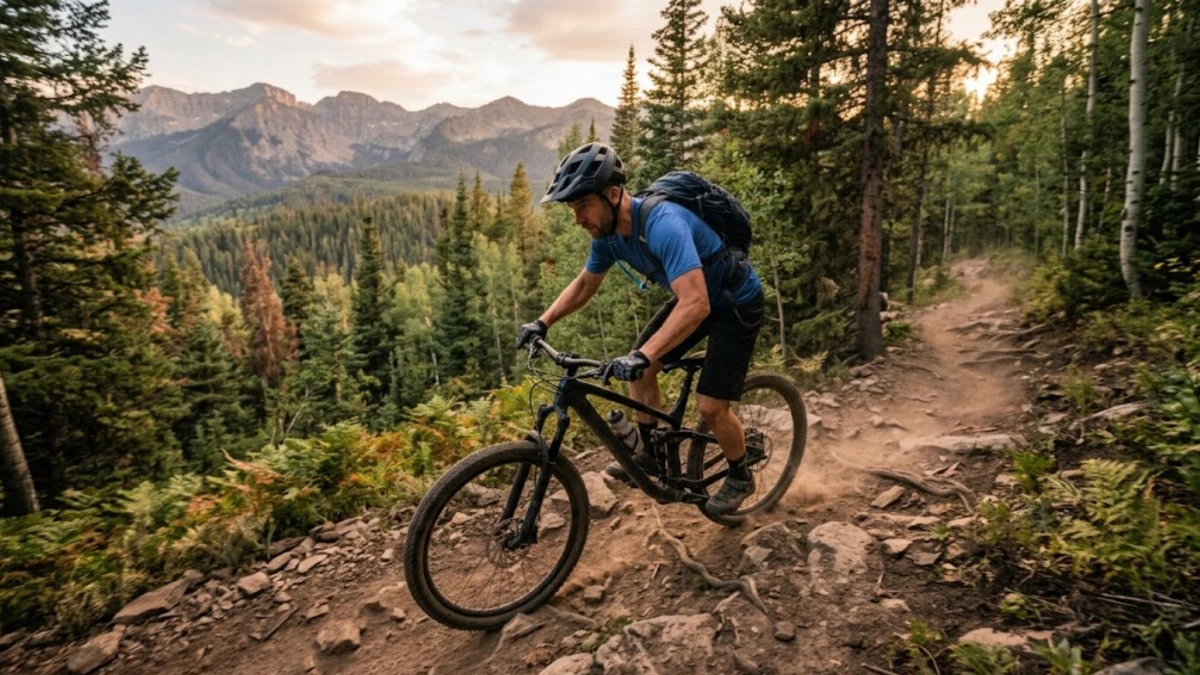
I didn’t get into mountain biking because I was fit. I got fit because of mountain biking — and there’s a difference. The trail doesn’t care how much you can bench press. It cares whether your legs are still firing on the third climb, whether your arms can absorb a rock garden without folding, and whether your head stays clear when the trail gets technical.
This guide is the foundation for everything we cover on training and fitness for mountain bikers — from building your engine on long climbs to what you eat before a ride to how you recover after one. It’s not a gym program borrowed from another sport and repackaged with a bike in the thumbnail. Everything here is built around what riding actually demands: endurance, strength, mobility, and the mental side that nobody talks about enough.
Why Mountain Biking Fitness Is Different
Road cycling is mostly one thing repeated: pedal, pedal, pedal. Mountain biking is five things happening in thirty seconds. You’re climbing, then you’re standing on the pedals muscling the bike over a root, then you’re seated again catching your breath, then you’re loading up for a drop, then you’re cornering hard enough that your forearms are burning from the grip alone.
That variability is why generic fitness advice falls flat for riders. You don’t just need a big aerobic engine — you need strength that shows up in short, sharp bursts, a core that keeps you stable when the trail throws you off balance, and enough mobility that getting low over the bars doesn’t feel like a fight with your own hips. Train for one of those and ignore the rest, and you’ll hit a ceiling fast — usually on the exact terrain you were hoping to get better at.
The Core Pillars: Endurance, Strength, Core, Mobility, Mind
I think about MTB fitness as five separate systems that all have to work together.
Endurance is your ability to keep putting out effort without falling apart. This is the one most riders default to training — ride more — and honestly, that’s not wrong as a starting point. We’ll go deep on how to actually build that engine, including the case for slower, steady miles versus higher-intensity work, and where something like structured interval sessions or Zone 2 training fits into a rider’s week.
Strength is what lets you move the bike instead of the bike moving you. Leg strength shows up on climbs and out of corners. Upper body strength shows up everywhere you’d expect it least — pumping through a rock garden, muscling the front end up onto a ledge, staying composed through a rough descent. We’ll break down leg-specific work for climbing and sprinting, upper body training built around downhill and jump riding, and a shortlist of the strength exercises that carry over to the bike best — whether you’ve got a full gym or nothing but your own bodyweight.
Core strength doesn’t get the attention it deserves. It’s not about visible abs — it’s about your torso staying stable while your arms and legs are doing completely different things at the same time. A weak core means power leaks out before it ever reaches the pedals, and it’s usually the first thing to fatigue on a long, rough descent. We’ve got a full breakdown coming on building that stability specifically for riding, not for a mirror.
Mobility is the one riders notice only when it’s missing — usually as stiffness that shows up the day after a ride, or as a hip or shoulder that just won’t let you get into an aggressive position on technical terrain. A dedicated stretching routine and some targeted mobility work for the hips and shoulders solve more problems than people expect.
Mental toughness rounds it out, and it’s not separate from the physical side — it’s downstream of it. When your body’s not gassed, your decision-making on a sketchy line gets a lot clearer. But there’s a direct-training side to this too, from managing fear on committing terrain to visualization work before you drop into something you’ve been building up to.
Where to Start (Without Overhauling Your Life)
You don’t need to fix all five pillars at once, and you definitely don’t need to quit your job and become a full-time athlete. Start with what you’ve got.
If you’re new to structured training entirely, there’s a beginner-focused path worth starting with rather than jumping straight into anything advanced — it saves you from the classic mistake of doing too much, too soon, and burning out in three weeks. Beyond that, the single highest-leverage habit is simple: ride more, consistently, and warm up properly before you do. A short, dedicated warm-up before you hit the trail does more for how the ride feels than almost anything else on this list, and it’s the easiest thing to skip when you’re excited to go.
From there, consistency beats intensity every time. Three moderate rides a week, every week, will make you a stronger rider faster than one brutal session followed by two weeks of nothing. And don’t ignore your body’s signals — sharp pain is different from normal fatigue, and knowing that difference is most of what keeps you off the injury list. We cover the most common ways riders get hurt, and how to avoid them, in more depth elsewhere on the site.
One more thing worth doing early: mix in activities that aren’t riding. Hiking, swimming, even just walking — cross-training builds general fitness without hammering the same muscles and joints every single day, and it’s one of the more underrated tools for staying injury-free over a long season.
Fueling the Ride: Nutrition That Actually Matters
Fitness and nutrition aren’t separate conversations — what you eat determines how much of your training actually sticks.
Pre-ride, the goal is simple: enough fuel to ride strong without feeling weighed down, and we’ve got a full guide on getting that timing right. For anything past an hour or two, you need a plan for eating on the bike too — long rides fall apart fast once you run out of onboard energy, which is exactly what our on-ride fueling guide is built to prevent. And recovery starts the moment you get off the bike, with what you eat in that window playing a real role in how sore you are the next day — something we cover in detail in our post-ride recovery nutrition piece.
Hydration deserves its own mention because it’s the easiest thing to get wrong. Even mild dehydration measurably affects strength, coordination, and endurance — the Mayo Clinic’s breakdown of dehydration is worth a read if you’ve ever wondered why a ride that should’ve felt fine turned into a slog by the second hour. We go deeper on hydration strategy specifically for riders elsewhere in this hub.
Recovery: The Part Everyone Skips
Here’s something that took me longer to learn than it should have: you don’t get stronger during the ride. You get stronger in the days after it, when your body actually repairs itself. Skip recovery, and you’re just accumulating fatigue, not fitness.
Sleep is the single biggest lever here — more than any supplement or recovery gadget — and we’ve got a dedicated piece on exactly why that is. On the days between hard rides, active recovery — easy movement instead of total rest — tends to speed things along better than doing nothing at all, which is counterintuitive until you try it. Simple habits like a proper cool-down after every ride and foam rolling for the muscles that take the most abuse round out the picture, and we’ve written full guides on both.
Building a Training Plan That Fits Your Riding
You don’t need anything complicated to start. Ride two to three times a week, mixing easy efforts with harder ones. Add strength work once or twice a week — whether that’s structured gym sessions or bodyweight training you can do anywhere, both of which we cover in full. Stretch or work on mobility a few times a week, especially after rides. Prioritize sleep and real food daily. That’s it. That’s a legitimate plan.
As you get more dialed in, there’s room to go deeper — understanding heart rate zones. Hence,o your “easy” days are actually easy, or periodizing your training across a season instead of riding the same way in March as you do in August. And if your riding leans a specific direction, train for it specifically: technical climbing rewards a different kind of fitness than fast, technical descending does, and we’ve got focused guides on both. Riders chasing race results or bigger objectives will eventually want a more structured, advanced approach too — that’s its own conversation, and one we get into separately.
For a broader look at why regular physical activity matters beyond the bike, the CDC’s Physical Activity Basics and Your Health page is a solid, no-nonsense reference — a lot of what applies to general health applies directly to how you’ll feel on the trail too.
Final Word
None of this is about turning riding into a chore. It’s the opposite — the fitter you get, the more the bike disappears underneath you, and the more you read terrain and have fun instead of surviving the climb back to the trailhead. Pick one piece of this guide, the one that matches whatever’s been holding your rides back lately, and start there. Everything else compounds from that first step.