

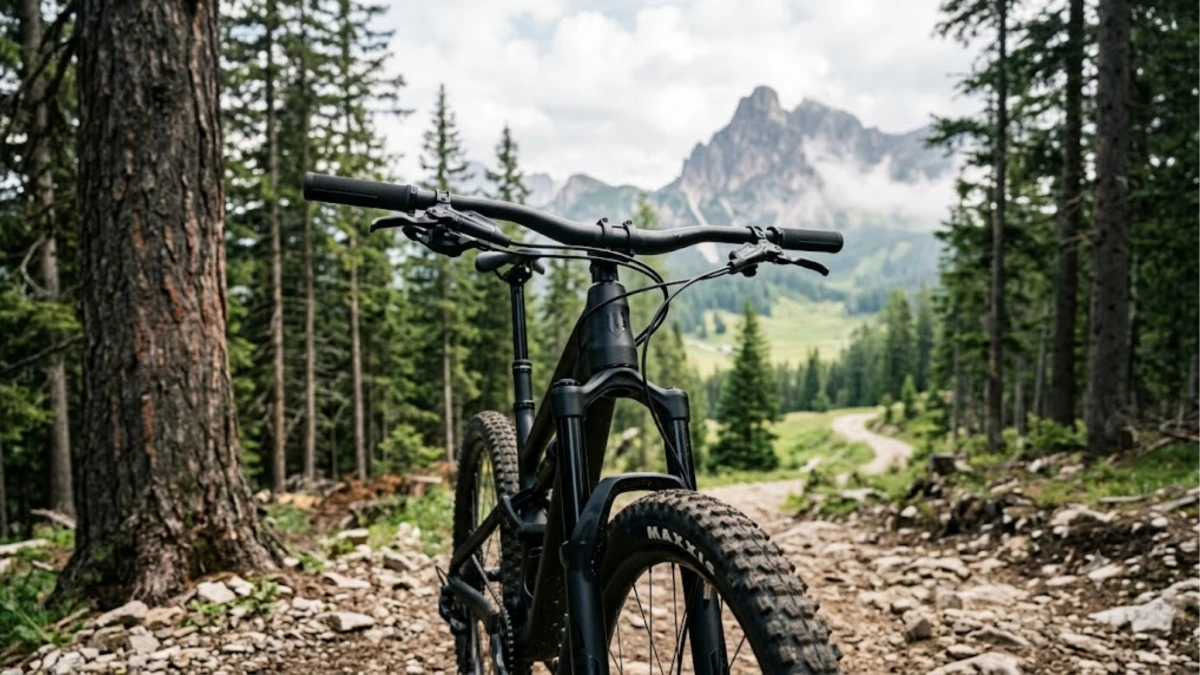
The first time I bought a real mountain bike, the guy at the shop asked what travel I wanted, and I nodded as I understood. I didn’t. It took a full season of riding, breaking, and replacing parts before the bike stopped feeling like a mystery box and started feeling like a tool I actually understood.
This guide is the version of that season I wish I’d had on day one. We’re going to walk through every major system on a mountain bike — frame, suspension, drivetrain, brakes, wheels, and the parts where your body actually touches the bike — in plain language, with links to full deep-dive guides on anything you want to go further on.
The Frame & Geometry
Most frames today are aluminum — strong, affordable, and the default choice for good reason. Carbon fiber shows up on lighter, pricier builds; steel and titanium are less common but still around for riders chasing a specific ride feel—full breakdown here: Understanding Mountain Bike Frame Materials.
The other frame decision that actually changes how a bike rides is hardtail versus full suspension. A hardtail is lighter, simpler, and a great way to build real trail skills; full suspension adds a rear shock that keeps your back wheel tracking on rough descents, at the cost of weight and price. If you’re stuck on this decision, see Hardtail vs. Full Suspension: Which is Right for You?
Then there’s geometry — the angles and measurements that determine how a bike feels underneath you. A slacker front end feels planted at speed; steeper angles make a bike quicker to turn and better suited to climbing—more on this in Understanding Mountain Bike Geometry.
Your frame also takes a beating on the trail — tape, guards, and wraps go a long way toward keeping it (and its resale value) intact. See Frame Protection for Mountain Bikes: Guards, Tapes, and Wraps.
Suspension: Forks and Rear Shocks
Suspension keeps your wheels in contact with the ground through two components: the front fork and, on full-suspension bikes, the rear shock.
The fork holds your front wheel, with a spring and damper inside that absorb impacts and control rebound. Cheaper forks are set-and-forget; higher-end forks let you tune compression and rebound independently. REI’s suspension basics guide is a good primer on how the damping and spring systems actually work. For the full picture, see The Ultimate Guide to Mountain Bike Suspension Forks.
The rear shock does the same job as the front shock on full-suspension bikes — and getting “sag” dialed in for your weight matters just as much as picking the right fork. Full walkthrough: Rear Shock Setup and Tuning for Mountain Bikes.
The Drivetrain: Cranks, Chain, Cassette, Shifters
Cranks, chainring(s), chain, cassette, derailleur, and shifters all work together to turn your pedaling into forward motion. If you want it laid out from zero, start with the Beginner’s Guide to Mountain Bike Drivetrains.
Most modern trail bikes run a single front chainring — a “1x” setup — which simplifies shifting. Chainring size affects your overall gear range; see Mountain Bike Cranks and Chainrings: A Buyer’s Guide. The chain itself is the unglamorous workhorse of the system — worth a read before yours starts skipping: Mountain Bike Chains: Types, Maintenance, and Replacement.
At the rear wheel, the cassette (or, less commonly, a freewheel) gives you your range of gears — Cassette and Freewheel Differences for Mountain Bikes explains why cassettes have mostly won out. Shifters move the chain; trigger shifters are the standard, though twist and electronic options exist too, covered in Mountain Bike Shifters: Trigger, Twist, and Electronic.
One small part deserves a special mention: the derailleur hanger. It’s a deliberately weak link that bends or snaps before your derailleur or frame does — worth knowing about before it happens to you, in Derailleur Hangers: What They Are and Why They Break. And because a drivetrain wears out quickly when it’s dirty, regular cleaning and lubrication matter more than almost any other maintenance task — see Maintaining Your Mountain Bike Drivetrain.
Brakes: Disc, Hydraulic, and Rotors
Nearly every mountain bike sold today runs disc brakes, delivering consistent stopping power in mud, rain, and dust in a way old-school rim brakes never could. If you’re comparing options, see Choosing the Best Mountain Bike Brakes.
Rotor size affects both stopping power and heat management — larger rotors dissipate heat more effectively on long, steep descents. See Brake Rotor Types and Sizes for Mountain Bikes.
Most disc brakes on modern mountain bikes are hydraulic — more power, more consistency, less hand fatigue — but they need occasional bleeding to clear air from the lines. REI’s guide to disc brake care covers the inspection basics; for the bleeding process itself, see Hydraulic Disc Brakes: Troubleshooting and Maintenance.
Wheels and Tires: Sizes, Tubeless, Upgrades
Wheels and tires are the only parts of the bike actually touching the trail, which makes them disproportionately important to how a bike feels and performs.
The first real decision is wheel size — 27.5-inch or 29-inch. Smaller wheels tend to feel more playful and accelerate quicker; 29ers roll over obstacles more easily and hold speed better. See Mountain Bike Wheel Sizes Explained: 27.5 vs. 29er.
Tires matter just as much —arguably more: tread pattern, width, and rubber compound all affect how a bike handles. See How to Choose the Right Mountain Bike Tires.
Most mountain bikers today run tubeless, which lets you run lower pressure for better grip and all but eliminates pinch flats. See Tubeless vs. Tubed Mountain Bike Tires.
New wheels are one of the highest-impact upgrades available on their own — see Upgrading Your Mountain Bike Wheels: What to Look For. Under the rim, spokes and their lacing pattern determine wheel strength and stiffness — more technical than it looks; see Spokes and Lacing Patterns in Mountain Bike Wheels. At the center of it all is the hub, which houses the bearings and, on the rear wheel, the freehub — modern hubs come in different spacing standards like Boost and different engagement speeds, demystified in Understanding Mountain Bike Hubs: Boost, Non-Boost, and Engagement.
Cockpit: Saddle, Handlebars, Grips, Pedals
Start with the saddle: a good one disappears under you, a bad one ruins a ride. It’s a genuinely personal choice — see Selecting the Perfect Mountain Bike Saddle. Most bikes use a fixed seatpost, but the dropper post has become close to standard on trail bikes — it lets you drop your saddle for descents and raise it for climbing. See The Importance of Mountain Bike Dropper Posts and, for the fuller picture including fixed and suspension posts, Mountain Bike Seatposts: Fixed, Suspension, and Dropper Options.
Handlebars are wide on mountain bikes for leverage and control, and their rise and sweep shape your riding position more than most riders realize — see Mountain Bike Handlebars: Width, Rise, and Sweep. The stem connecting your bars to the fork has an outsized effect on handling, too: shorter stems feel quicker, longer stems stretch you out, and can help with climbing efficiency. See Mountain Bike Stems: Length, Angle, and Material. Grips are the smallest of these parts but matter more than their size suggests for comfort and control — see Choosing Mountain Bike Grips for Comfort and Control.
Then there are pedals — flat or clipless, a real debate in the sport. Flats are simple and forgiving; clipless locks your shoe in for a more direct, efficient connection at the cost of a learning curve. See Clipless vs. Flat Pedals: A Mountain Biker’s Dilemma and Choosing the Right Mountain Bike Pedals for Your Riding Style.
Choosing the Right Components for You
None of these systems work in isolation — a great fork paired with a mismatched frame geometry, or top-end brakes bolted to wheels that flex under load, won’t add up to the bike you’re hoping for. You don’t need to memorize all of this before your next ride. Pick the section that matches whatever’s on your mind right now and go deeper from there. The rest will come with time in the saddle.