
I still remember the first time I forgot I was clipped in. Stopped dead at a trail junction, tipped over sideways at about half a mile an hour, and lay there a second before my riding buddy stopped laughing long enough to ask if I was okay. That’s the initiation nobody warns you about with clipless pedals, and it’s exactly why this question trips up more new riders than almost anything else in our main guide to mountain bike components.
Both systems work. Neither is objectively better. What matters is matching the pedal to how you actually ride, not to what looks more “legit” at the trailhead.
How Flat Pedals Actually Work
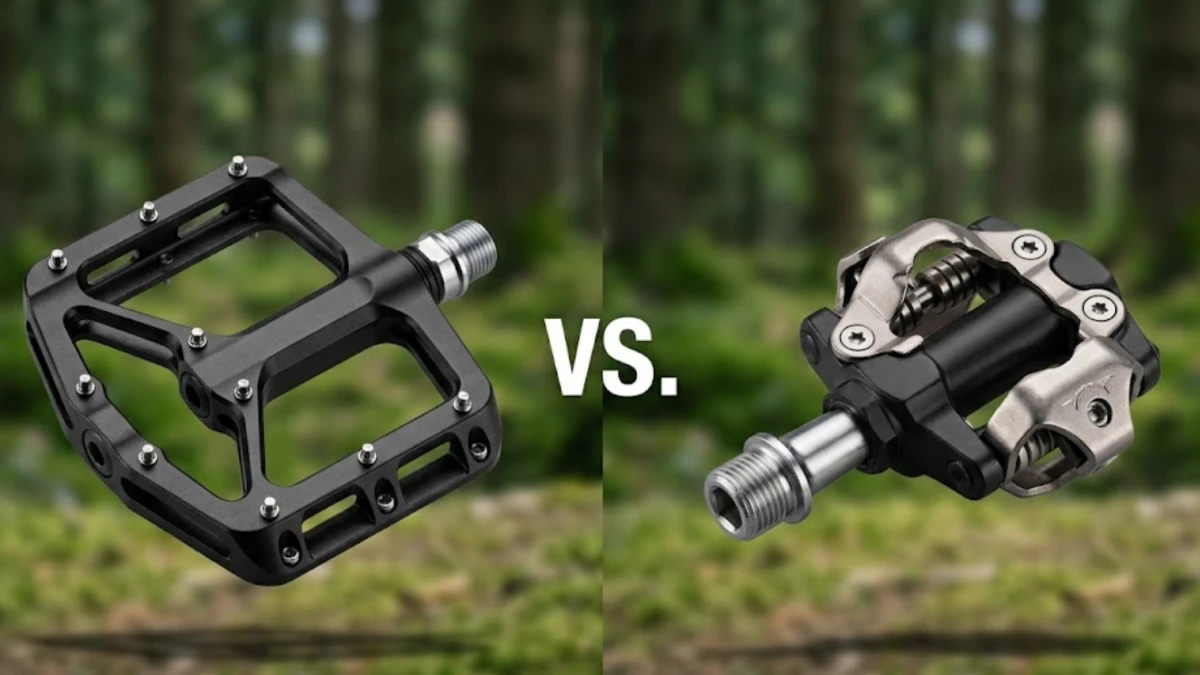
A flat pedal is a platform — nothing clips, nothing locks. Your shoe sits on top, and grip comes from friction between the sole and a ring of metal pins pressed into the pedal body. Good flat pedals for mountain biking aren’t the plastic ones bolted to a department-store bike; they’re forged or machined aluminum, wide enough to support your whole foot, with pins you can adjust for bite.
The trade-off is honest: your foot can leave the pedal any time, for better or worse. On a loose, rooty descent that’s a feature — you plant a foot, catch your balance, and keep moving. On a punchy climb where you’re standing and mashing, it’s the reason your foot can bounce loose if your line gets rough. Pair flats with a dedicated flat-pedal shoe — something like a Five Ten with a sticky rubber compound — and that bounce problem mostly goes away.
How Clipless Pedals Work — and Why They’re Called That
Clipless pedals use a cleat bolted to the sole of a dedicated shoe, which locks into a spring-loaded mechanism on the pedal. You click in by stepping down, and click out with a twist of the heel. The name is a leftover from cycling history: before this system existed, riders used metal-and-strap “toe clips” bolted to the front of the pedal to keep their feet in place. When the French company Look released the first widely adopted step-in pedal design, the industry called it “clipless” simply because the old toe clip was gone.
Shimano’s SPD system is the one you’ll see most on trail and XC bikes, with Crankbrothers’ Eggbeater and Mallet lines close behind. Worth knowing before you buy: the assumption that clipless automatically means more pedaling efficiency isn’t as settled as it sounds. Wikipedia’s rundown points to peer-reviewed research finding no measurable advantage in mechanical efficiency between the two systems for either casual or elite riders. Where clipless genuinely earns its keep on a mountain bike isn’t raw wattage — it’s retention on rough, high-speed terrain where a foot bouncing off the pedal costs you more than any efficiency gain would.
The Real Trade-Offs
Control on rough ground. Clipless keeps your foot locked to the pedal through braking bumps, root gardens, and off-camber sections where a flat pedal foot can get knocked loose. If you’re riding fast, technical terrain regularly, that security matters more than most beginners expect.
Bailing out. Flats win here, full stop. No twist-to-release, no learning curve, no risk of going down because you forgot to unclip at a stop sign. If you’re still building confidence on technical features, that instant escape hatch is worth more than any efficiency argument.
Learning body position. This is the one people underrate. Riding flats forces you to actually balance on the bike — shifting weight, absorbing terrain with your knees and hips instead of relying on being mechanically attached. A lot of riders who go clipless too early skip past skills they’d have built naturally on flats, and it shows up later as sloppy technique on steep, technical ground.
Mud and mechanical failure. Cleats can clog in thick mud, and a pedal mechanism can occasionally fail to release. It’s rarer with modern pedals than it used to be, but it’s a real consideration if you ride wet, sloppy trails often.
Who Should Run Flats
New riders, technical trail players, and downhill/freeride riders who need instant foot mobility all lean toward flats — and plenty of experienced racers still run them by choice. If you’re newer to the sport, REI’s pedal buying guide makes the same case most experienced mechanics will: starting on flats and getting comfortable with the bike before adding a mechanical connection tends to build better instincts than skipping straight to clipless.
Who Should Run Clipless
Cross-country racers, long-distance riders logging big vert, and anyone with solid bike-handling skills who wants the retention benefit on rough terrain are the clearest fits. If you’re already comfortable popping the bike over obstacles and reading a trail at speed, the twist-out learning curve is a short one — a few parking-lot practice sessions, and it becomes automatic.
Making the Switch (or Not)
No rule says you have to graduate to clipless eventually. I know riders who’ve spent fifteen years on flats and have zero interest in changing, and I know racers who went clipless in their first season and never looked back. If you do want to try clipless, do it somewhere low-stakes first — a flat parking lot, not a rock garden — and expect at least one slow-speed tip-over before it clicks.
Whichever system you land on, the pedal is just one piece of how power actually gets to the ground. It’s worth understanding how your cranks handle that power transfer once you’ve settled on a pedal type, and keeping the rest of your drivetrain in good shape so nothing you’ve dialed in on the pedal end gets wasted somewhere else in the system. And if you’re still weighing specific pedal models rather than just the flat-vs-clipless question, picking pedals for your specific riding style is the natural next read.