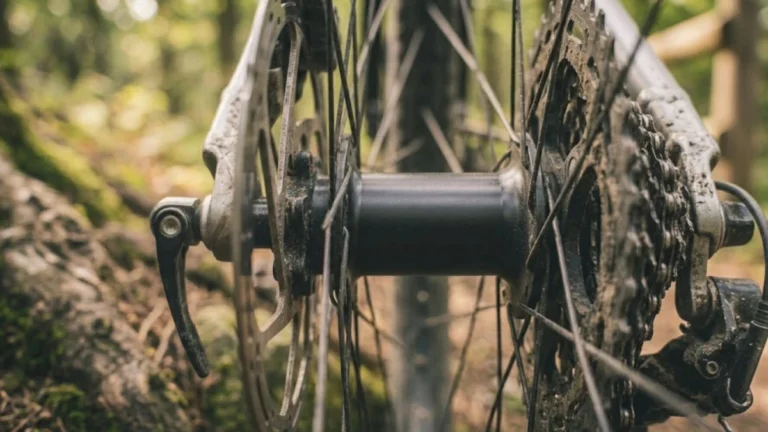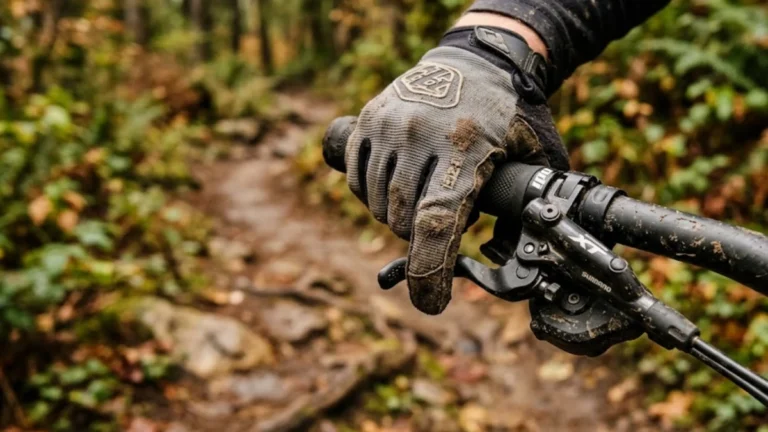

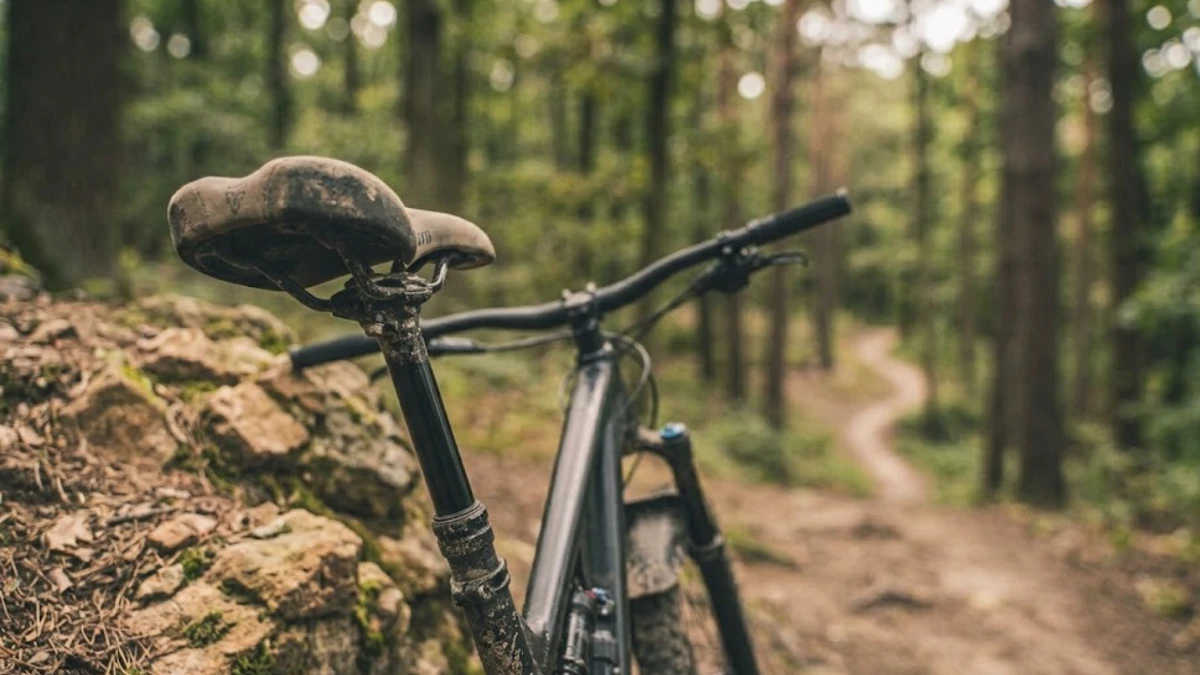
I ran a fixed post on my first hardtail for two full seasons before I understood what I was missing. Then I dropped into a rock garden with my seat still at climbing height and ate a bar-first tumble I still think about. This guide breaks down the three seatpost types — fixed, suspension, and dropper — so you don’t learn that lesson the hard way, and it fits into our main guide to mountain bike components if you want the bigger picture first.
Why the Seatpost You Choose Actually Matters
A seatpost looks like the least interesting tube on your bike. It’s not. It’s the difference between pedaling efficiently on a climb and being pinned in place when the trail points downhill and gets technical. Saddle height affects your pedaling power directly — too low and you’re losing leverage on every stroke, too high and you’re rocking your hips to complete a revolution. That’s fine to set once on a gravel bike. On a mountain bike, where the terrain under you changes every thirty seconds, a post that can’t adapt becomes a limitation you work around instead of a tool that works for you.
This ties directly into your riding position more broadly — saddle height interacts with reach, stack, and how far back you can get your weight on a descent, which is why it’s worth reading alongside our geometry breakdown if you’re setting up a new bike from scratch.
Fixed Seatposts: Simple, Light, and Still Relevant
A fixed post is exactly what it sounds like — a tube with a saddle clamp on top, held at one height by a collar clamp on your frame: no cartridge, no cable, nothing to bleed or charge. I still run one on my rigid singlespeed, and there’s something honest about a component with exactly one job that does it forever.
The appeal is straightforward. Fixed posts are the lightest option by a real margin; they’re the cheapest by an even bigger one, and there’s essentially nothing on them to fail. That reliability is genuine — I’ve had fixed posts outlast three other bikes.
The trade-off is equally straightforward: you’re stuck with one height until you stop, loosen a clamp, and manually adjust on smooth singletrack or gravel, which is a non-issue. On a trail with a real descent partway through a ride, it means either riding down with your seat too high and your movement restricted, or stopping to drop it and stopping again to raise it. If you’re building a budget hardtail for fire roads and mellow singletrack, or you’re weight-weenie racing XC where every gram matters more than mid-ride adjustability, a fixed post is a legitimate choice, not a compromise.
Suspension Seatposts: A Middle Ground Worth Understanding
Suspension posts sit between fixed and dropper, and they solve a different problem entirely — comfort, not positioning. Instead of a solid tube, there’s a spring or elastomer built into the post that lets the saddle move a small amount vertically, soaking up chatter from washboard gravel or rough pavement before it reaches your spine.
I tried one for a season on a commuter build, and the comfort gain on rough fire road was noticeable — less fatigue in my lower back after long days in the saddle. What it doesn’t do is help you move your body around on technical terrain, since the saddle stays roughly where it was, just cushioned. Some riders also find the bob distracting when they’re pedaling hard out of the saddle, since a soft suspension post gives a little under load.
Suspension posts make the most sense for gravel riding, commuting, or light cross-country where the priority is smoothing out small bumps rather than getting the saddle out of the way for a real descent. If you’re riding actual mountain bike trails with meaningful elevation change, this isn’t the category solving your problem — the next one is.
Dropper Posts: The Component That Changed How We Ride
The dropper post is the reason modern trail bikes feel so different from the hardtails I grew up on. A handlebar-mounted remote lets you drop the saddle out of the way mid-ride and bring it back up just as fast, with no stopping, no tools, no fumbling with a quick-release clamp on a loose section of trail. Mechanically, it’s a telescoping unit — an outer sleeve clamped into your frame with an inner piston that travels through a set range, triggered remotely by that bar-mounted lever, as Wikipedia’s overview of the technology lays out in more depth if you want the full mechanical breakdown.
What that gets you on the trail is real. With the saddle down, you can get your weight back and low on steep terrain, absorb square-edge hits with your legs instead of your spine, and lean the bike into corners the way you can’t with a saddle in the way. I didn’t fully trust a dropper until I rode a rooty descent I’d walked twice before, and the difference wasn’t subtle — it was the gap between white-knuckling a section and actually riding it.
According to REI’s mountain bike buying guide, droppers have become common enough that most experienced riders today would struggle to go back to riding without one, and most mid- to higher-end trail bikes now ship with one from the factory. If the bike you’re eyeing doesn’t have one, it’s one of the more worthwhile upgrades you can make — we cover the full case for running one here in our dropper post guide.
The costs are real too. Droppers are the most expensive seatpost category; they add weight from the internal mechanism and cable or hose, and they have more parts that can eventually need service — bushings wear, seals can start weeping, and a post can develop a slow return or a bit of side-to-side play over time. None of that has stopped me from putting one on every trail bike I own, but it’s worth knowing going in.
Diameter, Length, and Compatibility — Get This Right First
Before you buy any seatpost, check your frame’s seat tube diameter. As BikeRadar’s seatpost breakdown lays out, modern mountain bikes commonly run 30.9mm or 31.6mm, with 34.9mm showing up on some longer-travel dropper posts where the extra material adds stiffness and durability. In comparison, 27.2mm is mostly confined to older or XC-focused frames. This number is usually stamped near the base of your current post, and it’s non-negotiable — a shim can sometimes bridge a small gap, but you can’t force an oversized post into an undersized frame.
Insertion length matters just as much, especially for droppers — you need enough room in your seat tube for the post to actually sit at a usable travel range without bottoming into your bottom bracket. This is also where fit ties back into the rest of your cockpit: dialing in the rest of your riding position — bar width, stem length, saddle shape — only pays off if your seatpost height and setback are right to begin with, and the saddle you pair it with matters just as much as the post underneath it.
Keeping Any Seatpost Running Right
Regardless of which type you run, the post’s shaft — the part that slides in and out of the frame — needs to stay clean. Grit working its way into the seat tube scratches the shaft and, on a dropper, can chew up the internal seals over time. I wipe mine down after every muddy ride and drop a small amount of the manufacturer-recommended lube on the stanchion periodically, not the sprayed-everywhere kind you’d use on a chain.
For fixed and suspension posts, that’s most of the maintenance story. For droppers, watch for a soft or delayed return, side-to-side play at full extension, or a post that won’t hold its position under load—those are signs it’s due for service, either at home if you’re comfortable or at a shop. If drivetrain grime is finding its way onto your post too, it’s worth tightening up your routine drivetrain care at the same time, since the two areas of the bike tend to get dirty together.
Which One Actually Fits Your Riding
If you’re on smooth trails or gravel and counting grams, a fixed post is nothing to apologize for. If comfort on rough, mostly flat terrain is the priority, a suspension post earns its keep. But if you’re riding trails with real climbs and real descents — which describes most mountain biking worth doing — a dropper post is the upgrade that changes how the bike rides more than almost anything else you could buy. I’ve put droppers on bikes that had no business needing one and never regretted it. Figure out what you’re actually riding, then buy the post that matches it, not the one that looks best on a spec sheet.