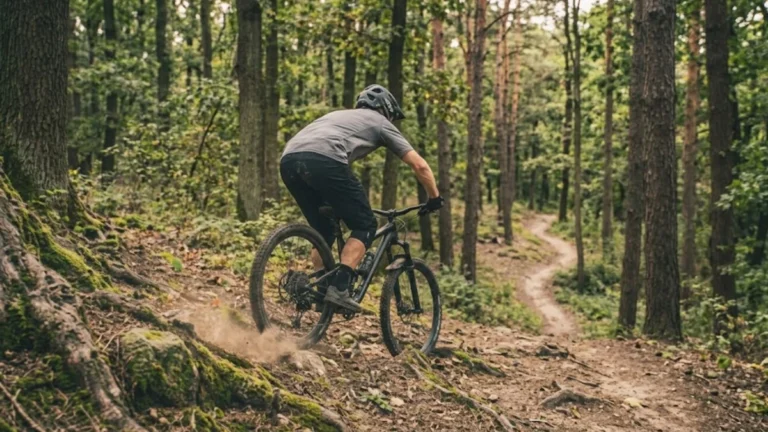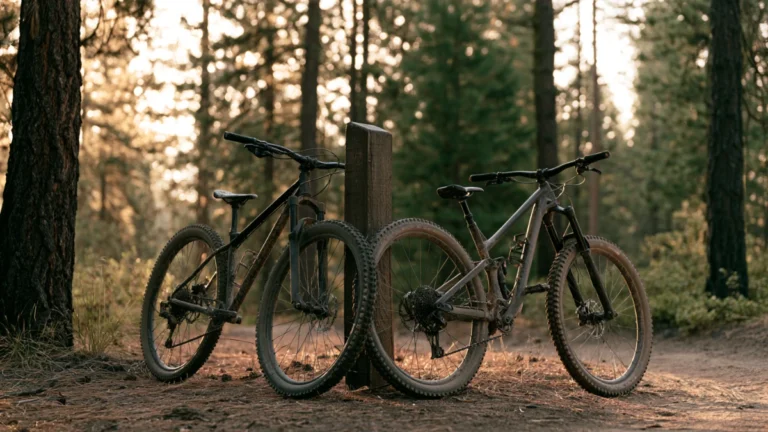

I ran the wrong tire combination on a rocky loop outside Moab for exactly one lap before I flatted twice and slid through a corner I usually clear without thinking. Tires are the one component most riders under-think, and they’re the one that actually decides how much grip, speed, and confidence you have on the trail.
This guide breaks down what tread, width, and compound actually do, then matches them to the terrain you ride most, so you pick rubber on purpose instead of whatever’s in stock. It’s part of our main guide to mountain bike components, where we cover everything else that shapes how your bike handles.
Tread, Width, and Compound: What’s Actually Doing the Work
Every mountain bike tire is a combination of three variables, and understanding what each one does on its own is the whole game.
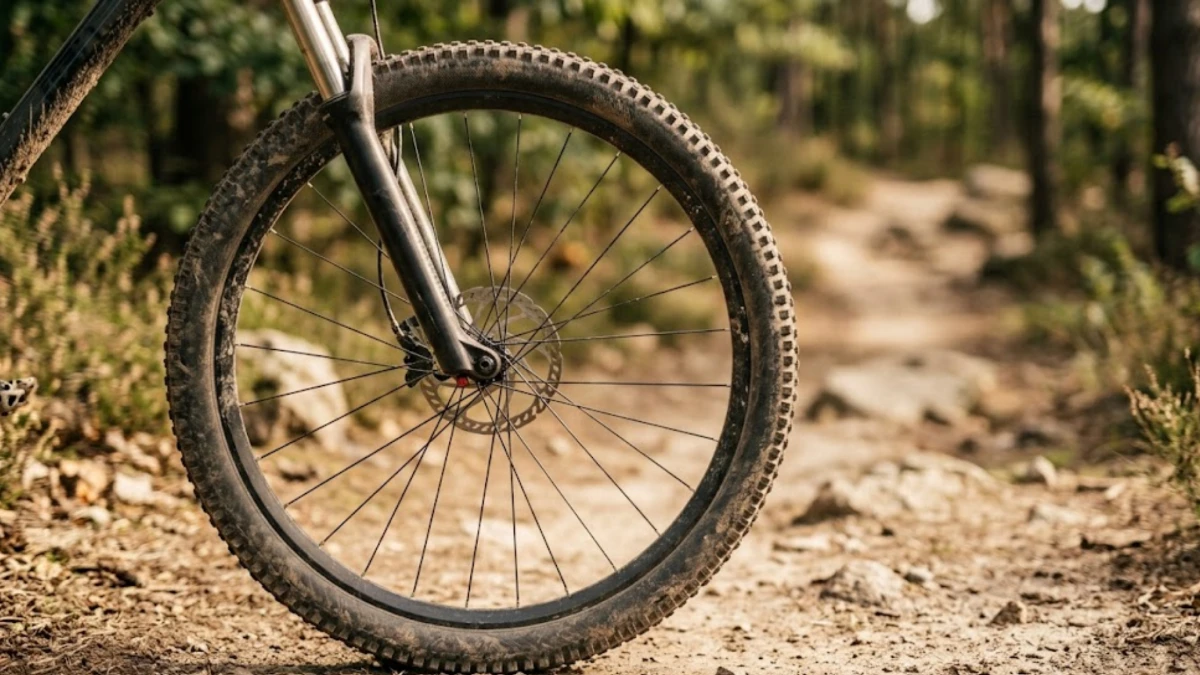
Tread and knob spacing. Tall, widely spaced knobs dig into soft or loose dirt and shed mud instead of packing up with it — that’s why you see them on wet-weather and enduro tires. Short, tightly packed knobs roll fast and quiet on hardpack but squirm and slide once the dirt gets loose. Spacing matters as much as height: wide gaps clear mud, tight gaps roll faster and feel more planted on hard surfaces. Manufacturers also vary the shape — ramped center knobs for rolling speed, square-edged shoulder knobs for cornering bite, taller outer knobs for braking traction in corners. None of it is arbitrary.
Width. A 2.5″ tire puts more rubber on the ground than a 2.2″, which means more grip and more air volume to run lower pressure without pinch-flatting or squirming through corners. That’s why trail and enduro bikes have trended wider over the past few seasons. It comes at a cost, though — wider tires weigh more and spin up slower, so racers chasing lap times still lean narrower. Cross-country tires typically run 1.9″ to 2.3″, trail and all-mountain bikes sit in the 2.3″ to 2.5″ range, and downhill tires push up toward 2.5″ or beyond, according to REI’s tire-buying guide. Your rim’s internal width and your frame’s tire clearance set the ceiling here, so check both before you fall in love with a fat tire your bike can’t actually run— and understand how wheel diameter affects the tire you can run.
Compound. This is the part riders skip past and shouldn’t. Softer rubber grips like Velcro on wet rock and roots but wears out faster; harder rubber lasts longer and rolls quicker but gives up outright traction. Most tires split the difference by using different compounds in different zones — a durable, fast-rolling center strip with softer shoulder knobs for cornering grip. Maxxis, for instance, runs a firmer 3C MaxxSpeed or dual-compound build for XC and a stickier, slower-rebounding 3C MaxxGrip for the front tire on aggressive trail and enduro builds, with 3C MaxxTerra sitting in between as the do-it-all option, per Maxxis’s own technology breakdown. Casing matters here too — a reinforced sidewall adds puncture protection and cornering support at the cost of some weight, which is worth it the moment you start hitting rock gardens with any regularity.
Matching Tires to the Terrain You Actually Ride
I’ve watched too many riders buy the tire on the coolest-looking bike in a magazine photo shoot instead of the tire suited to their actual trail system. Here’s how I’d sort it by conditions.
Dry, fast, hard-packed trails want the opposite of what your gut tells you to buy — short knobs, tight spacing, a harder compound, and a narrower width around 2.1″ to 2.3″. Anything more aggressive adds drag you’ll feel on every climb.
Loose-over-hardpack — the sandy, gravelly trail surface common through a lot of the American Southwest and Mountain West — needs something that can bite through the loose layer to the firmer base underneath. I run a medium-height, medium-spaced tread here, width around 2.3″ to 2.5″, and a compound that splits the difference between grip and rolling speed.
Wet, muddy, rooty trails are where tall, widely spaced knobs earn their keep, since they clear mud instead of caking up and going bald on you mid-ride. I’d stay in the 2.3″ to 2.5″ width range — go too wide and the tire floats on top of the mud instead of cutting through it — paired with a softer compound for grip on slick roots and wet rock.
Rocky, technical, enduro, or downhill terrain is where I stop compromising. Aggressive, tall knobs, width from 2.4″ up to 2.6″ or more for impact absorption, a soft sticky compound (especially up front), and a genuinely reinforced casing. I’ve cut a sidewall on an under-built tire in a rock garden exactly once, and I haven’t run a light-duty casing on that kind of trail since.
Front and Rear Aren’t the Same Job
It’s standard practice to run different tires front and rear, and there’s a real reason. Your front tire steers and does most of your braking, so it’s where I want maximum grip — bigger knobs, a stickier compound, no compromises. Your rear tire drives power to the ground and does its share of braking too, but a lot of riders — myself included, on faster trail days — run a slightly quicker-rolling rear tire to claw back some efficiency, accepting a touch less outright grip in exchange. Think of the front as commitment and the rear as efficiency; optimizing each for its actual job beats running a matched pair that’s mediocre at both.
Tubeless, Pressure, and the Setup That Actually Matters
Most riders on modern wheels are running tubeless at this point, and for good reason — the sealant plugs small punctures on the fly, you can run lower pressure for more grip and comfort, and pinch flats mostly disappear since there’s no tube to pinch. The trade-off is a messier initial setup and sealant that needs refreshing every few months. If your wheels are tubeless-ready, I’d make the switch—we cover it in detail here, including setup and troubleshooting. If you’re still on tubes and just learning the sport, don’t feel rushed; tubes work fine while you’re building trail time.
Pressure is where a lot of the “why does my bike feel squirmy” complaints actually live, and it’s usually not the tire’s fault — it’s 4 psi too low or too high for the rider’s weight and terrain. I’d rather you experiment in small increments on a familiar trail than chase a number off a forum post.
Dialing In Your Own Choice
Three questions actually decide this: what terrain do you ride most, what’s your priority (speed versus grip), and what’s your budget? Don’t buy for the one muddy weekend a year if your trail system is dry hardpack the other fifty.
If you’re newer to the sport, talk to riders at your local trailhead — they know exactly what holds up on your specific dirt, which beats any generalized advice, mine included. A solid all-rounder tire is a smart starting point; it won’t be the best tire for any single condition, but it’ll be good enough everywhere while you figure out what you actually want to optimize for. And remember that tire choice doesn’t happen in isolation — your brakes are only as good as the tire putting that power down, and a tire upgrade is also worth revisiting once you’ve settled on a wheel upgrade, since rim width changes how any given tire actually sits and performs.
There’s no universal “best” tire — there’s the right tire for your dirt, your riding, and what you’re trying to get better at. Start with the terrain, get the width and compound roughly right, and let a season of actual riding tell you the rest.